
Bridget Connor: my Irish Orphan 2nd Great-Grandmother.
Bridget Connare, survived the worst of the Great Irish Famine, as a ‘pauper’ in Loughrea Workhouse, County Galway. She was one of 4114 Irish Orphan Girls carefully selected by Lieutenant John Henry, the British Emigration Agent for the Colonial Land and Emigration Commission in Ireland, to come to Australia under the Earl Grey Scheme.
Between 1848 and 1850, 20 ships arrived in Eastern Australia. Bridget was onboard the Thomas Arbuthnot, of those onboard that vessel 192 stayed in Sydney at the Hyde Park Barracks until they were employed.[1]
In his book ‘Barefoot and Pregnant? Irish Famine Orphans in Australia’, historian, Dr Trevor McClaughlin, names the ships that arrived in Australia under the Scheme.[2] Also shown and arranged by date of arrival are the names of their young Irish female passengers in alphabetical order; Bridget Connare’s name is listed on the Thomas Arbuthnot: ‘Connare, Bridget, 15, Loughrea, Galway. Parents Patrick and Margaret (both dead) Religion, RC’.[3]
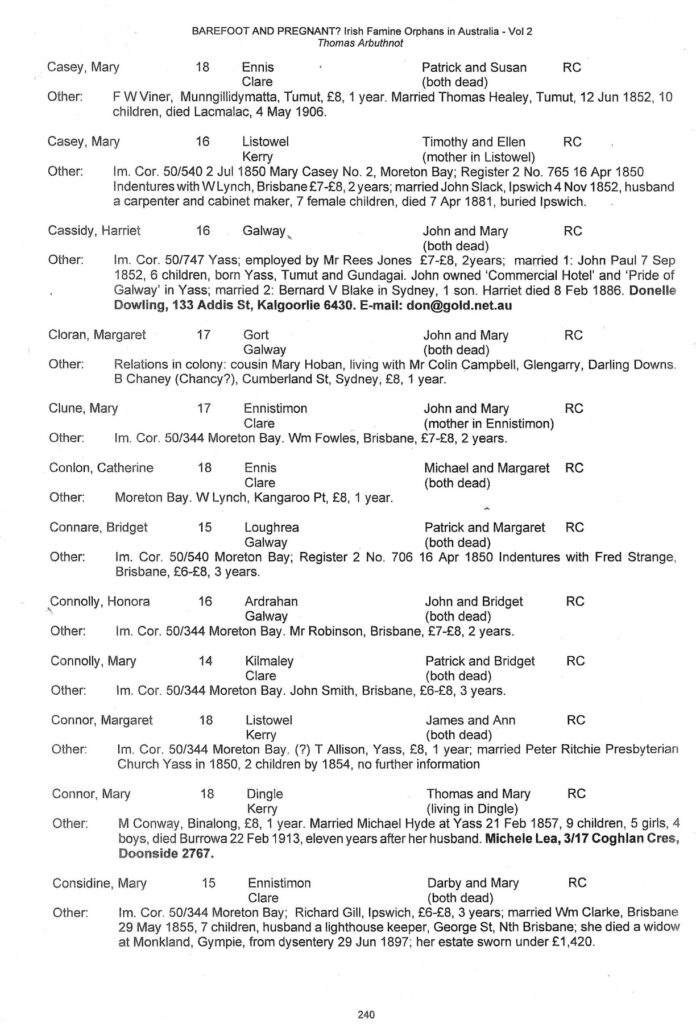
The Thomas Arbuthnot passengers. Source: Barefoot and Pregnant?: Irish Famine Orphans in Australia, Volume 2 by Trevor McClaughlin. Published by The Genealogical Society of Victoria. Permission to use image received from Trevor McClaughlin.
In October 1849, Bridget, one of 21 orphans left the Loughrea Workhouse, Galway, with her ‘sea chest’ of clothing and other items, and travelled across Ireland to the North Wall Quay in Dublin, from there the girls travelled on a crowded Irish steamboat to the Emigrant Depot in Plymouth, England.[4] This part of the journey paid for by the Poor Law Union, was described as the ‘worst part of the emigrant experience which resulted in four parliamentary enquiries between 1848 and 1854′.[5]
Dr. Charles Edward Strutt, Member of the Royal College of Surgeons Edinburgh (1814-1897) had accepted the position of Surgeon-Superintendent on the Thomas Arbuthnot, a fast-sailing wooden ship of 630 tons with three masts.[6] Strutt recognized that the Orphan girls had already experienced ‘their first trial of the discomforts of the sea on board an Irish steamboat’.[7] He immediately ‘ordered warm baths for a great number of them and about 130 to have haircut as they were not in a state to board the ship’.[8] The next day he examined the girls again, ‘They now appear a decent set of girls enough’.[9]
In the afternoon, Strutt and his girls boarded the Thomas Arbuthnot, where they spent the next two day settling into their allocated berths and messes. On Sunday 28 October at about 10 in the morning, the Thomas Arbuthnot ‘weighed anchor and sailed with a light breeze, passing Lizard during the night’.[10] Weather conditions on sailing ships were important, and winds, rain, ocean swells and ‘heavy rolling seas’ ‘left about 60 seasick’.[11] By early November, ‘Weather worse – a gale of wind with heavy sprays, about 45 seasick’.[12] An example of Strutt’s caring nature showed when he made a meat and sage pudding for ‘my sick girls’, as he called them.[13]
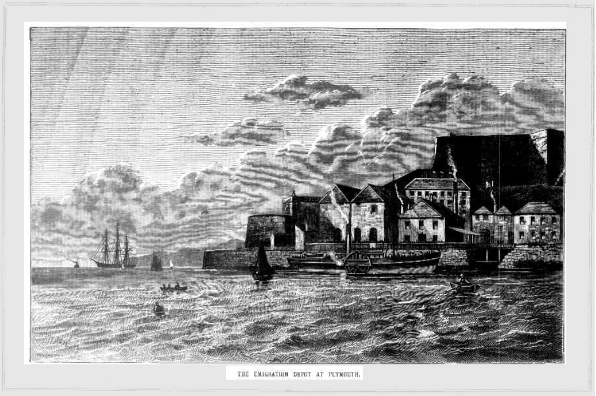
“The Emigration Depot at Plymouth.” The Sydney Mail and New South Wales Advertiser (NSW : 1871 – 1912) 17 January 1885: 111. Web. 14 Jan 2026.
By December, Strutt reported that the girls were getting into good habits of cleanliness, order and tidiness, and the school was well attended by 175 of the girls. A week later, he reported ‘My girls have become much more orderly and tidier under the constant steady pressure I keep up against holes, rags, tatters and dirt’.[14]
As Surgeon Superintendent, Strutt had specific instructions to follow including all daily activities, such as wash days on Monday and Friday, Sundays for Church services, establishing a school and choosing the teacher, activities like singing and dancing were to be encouraged, held on deck in the evenings weather permitting, and times to sleep, wake and eat. On Wednesday their wooden boxes were hauled on deck for the girls to take what they needed, which was done every three weeks.[15]
By Christmas Day the Thomas Arbuthnot was located off Cape of Good Hope. On Christmas Eve, the girls formed circles of seven or eight, and began to sing in Gaelic, a vocal ritual known as keening, traditionally only sung by women at wakes and funerals.[16] ‘Deploring their fate, old Ireland, their friends and relations’, which sounded to Strutt like a ‘dismal howling’ caused him to dispense the groups and Mrs Murphy gave the girls notice that the ‘keeners’ would have no pudding.[17]
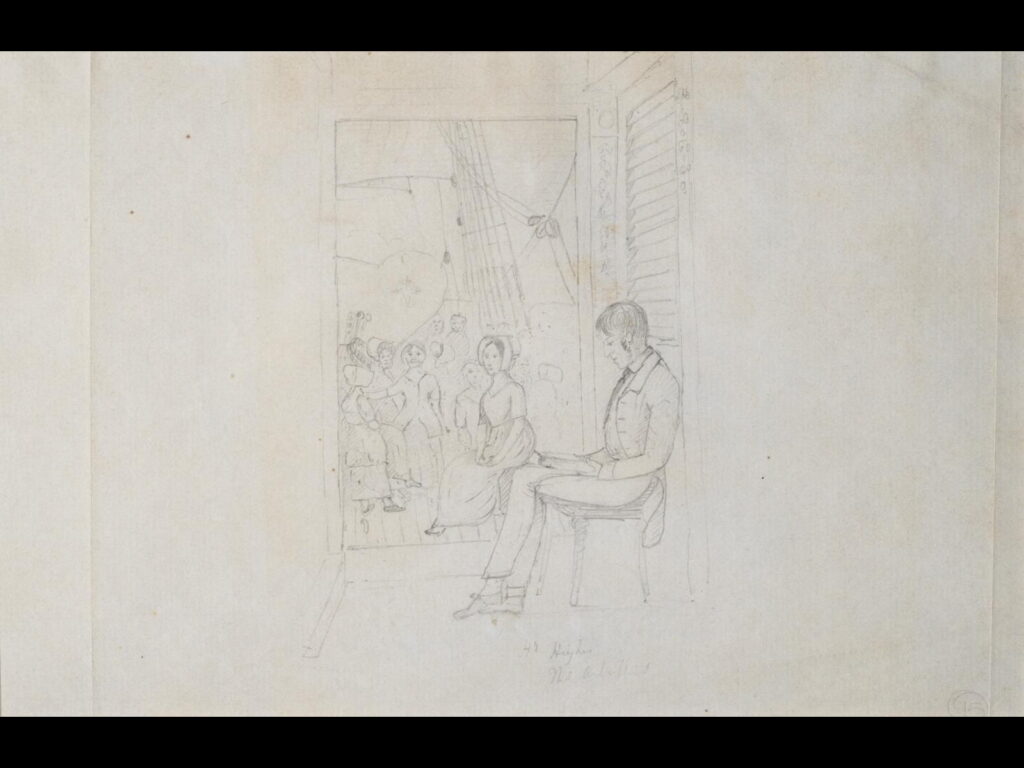
Pencil drawing on pale blue paper of shipboard life on the ‘Thomas Arbuthnot’, 1849. Object Number: 2005.0023.0001. National Museum of Australia.
During 21 – 24 January 1850, winds caused problems to keep on course, ‘forcing them to go around Van Dieman’s Land’.[18] On 29 January, ‘ship is making 200 miles a day’.[19] On Sunday 3 February 1850, a pilot guided the ship into the Heads, anchoring about dusk near Garden Island.[20]
After a voyage of 98 days, the 194 Irish Famine orphan girls left the Thomas Arbuthnot on Friday 8 February ‘weeping and wailing’ on leaving the ship as they came into Circular Quay to walk to the Depot. Strutt, showing his care and commitment to his girls, walked ahead of the group and stopped nearly all day with them to see that they were settled.[21]
Bridget spent 64 days at the Immigration Depot, signing an indenture to work for Frederick Strange of Brisbane, Moreton Bay, commencing on the 16 April 1850, at the agreed payment of £6 to £8 pounds, yearly for 3 years.[22]
Frederick Strange was a Naturalist and collector of plants, birds and shells.[23] The family moved from Sydney to Brisbane in March 1850. In 1852, Mr and Mrs Strange, three children and servant travelled to the UK on a business trip.[24] With the Strange family’s departure, Bridget was free to marry and shortly afterward on 12 February 1852, Bridget known as Bridge Connor, was married to George Evans, a Welshman from Liverpool, by Fr James Hanley, Brisbane’s first Catholic priest. George was not Catholic but appears to have become one prior to their marriage, with all ten children baptised Catholic.
Between 1866-1868 a survey was carried out listing all the Roman Catholic Householders in Fortitude Valley. George Evans, his wife and 6 children are listed as living in James Street.[25] Bridget died in 1908 and George pre-deceased her by ten years dying in 1898, they are survived today by 65 descendants to the 4th generation. Both passed away at their home in James Street surrounded by most of their family and were buried at Nudgee Cemetery.
[1] https://mhnsw.au/stories/general/remembering-great-irish-famine/
[2] McClaughlin, Trevor, ‘Barefoot and Pregnant? Irish Famine Orphans in Australia’, Volume 2, published, December 2001, by The Genealogical Society of Victory p.139-426
[3] McClaughlin, Trevor, ibid, p.240
[4] Lally, Stephen, ‘The Leaving of Loughrea. An Irish Family in the Great Famine.’ AuthorHouse, May 2013, eBook, chapter 10, p144
[5] Thomas Arbuthnot and Earl Grey© – Quin Heritage Group Michael Houlihan, 28 Feb 2022
[6] Thomas Arbuthnot Voyage – Convict Records
[7] https://www.facebook.com/GreatIrishFamineMemorial , Part 1-Emigration of Irish Orphans, posted August 26, 2013, accessed 20 Jan 2025, 9.25am
[8] Reid, Richard & Morgan, Cheryl. ‘a decent set of girls’ The Irish Famine orphans of the Thomas Arbuthnot’ 1849-1850, Yass Heritage Project,1990, p.29
[9] Reid, Richard & Morgan, Cheryl, ibid, p29
[10] Ibid, p31
[11] Ibid, p31
[12] Ibid, p33
[13] Ibid, p35
[14] Ibid, p37
[15] Ibid, p33
[16] Meanwhileinireland.com, Irish Funerals and Keening, (9) Meanwhile in Ireland | Facebook, posted August 27, 2022, accessed 19 Jan 2026, 8.39pm
[17] Reid, Richard & Morgan, Cheryl, Ibid, p39-40
[18] ibid, p43
[19] ibid, p44
[20] ibid, p44
[21] ibid, p46
[22] McClaughlin, Trevor, ibid, p.240
[23] Australian National Herbarium, Biographical Notes, Frederick Strange – biography
[24] The Moreton Bay Courier, Tues 23 March 1852. http://nla.gov.au/nla.news-article3711001
[25] Roman Catholic Church, Fortitude Valley Records OM89-13, Roman Catholic Church, Fortitude Valley Records, John Oxley Library, State Library of Queensland, Australia
Catherine I love this well researched story of your 2nd great grandmother and how wonderful to have a copy of that pencil sketch of life on her voyage to Australia. Your descriptions of the voyage really bring the experiences of your ancestor to life. thank you for a great story